


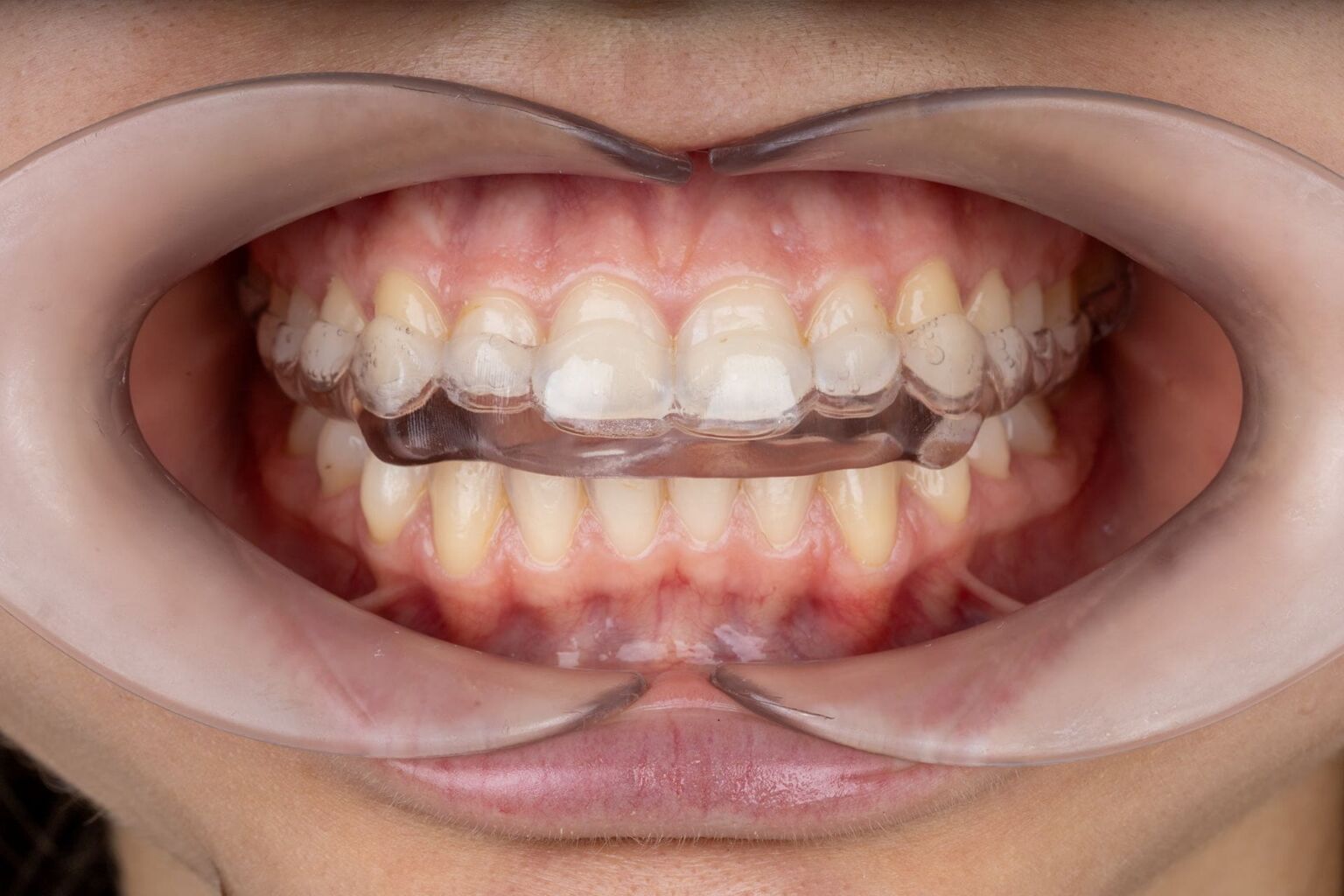
Modern dental splints are the first line of defense and the most effective remedy for three key problems:
- Bruxism (grinding and clenching the teeth): Unconscious clenching, most often at night, creates enormous forces that wear down enamel, cause teeth to crack, and destroy expensive dental work such as crowns and veneers. A splint acts as an impenetrable shield that absorbs all the force.
- Temporomandibular joint disorders: Clicking in the jaw, pain in front of the ear or a feeling that your jaw is “locked” are clear signs of joint overload, which a splint successfully relieves.
- Chronic headaches and neck pain: The jaw muscles are connected to the neck and head. When they are in constant spasm, severe tension headaches can occur.
Our approach to splint therapy
At the Arnautović practice, we do not see dental splints as ordinary pieces of plastic, but as extremely precise orthopedic appliances that successfully solve serious functional problems.
We use Michigan splints and MAGO splints, which we will discuss in more detail below. For now, we would like to point out that our philosophy, our approach to dentistry, is to always plan treatment from the end result and adapt all procedures to the desired goal.
In order to work more precisely and thoroughly, we also always use special dental loupes in our work.
Michigan splints
The Michigan splint is the gold standard when it comes to stabilization splints. It is a precisely made, hard acrylic splint most often worn on the upper jaw at night.
When the patient bites into this splint, it creates a perfectly flat and controlled contact with the lower teeth and achieves two key effects:
- Centering the temporomandibular joint: It forces the jaw joint to settle into its most natural and most relaxed position.
- “Switching off” the clenching reflex: Thanks to its special design and so-called canine guidance, as soon as you try to move the jaw to the side, the back teeth separate. This sends a signal to the brain to relax immediately and “reprogram” the muscles.
What does the procedure look like in the practice?
- The dentist thoroughly examines the teeth, muscles, and jaw movements.
- A precise impression is taken (conventional or digital using an intraoral scanner), together with a bite registration.
- The dental technician makes a clear, firm splint in the laboratory, specific to each patient.
- The most important step: in the patient’s mouth, the doctor checks and adjusts the splint with articulating paper until a perfectly micro-balanced bite is achieved.
MAGO splint
While the Michigan splint is used to relax the muscles and protect the teeth at night, the MAGO splint (short for Maxillary Anterior Guided Orthotic) represents a completely different therapy.
What makes the MAGO splint special:
- It is worn 24 hours a day: The patient wears it day and night and removes it only when brushing the teeth. The patient even eats with it in order to fully isolate the incorrect bite.
- It is actively adjusted: It requires regular visits to the dentist (every 1–2 weeks). By grinding and adding material, the dentist adjusts the splint as the joint gradually returns to its proper position.
This splint offers both a therapeutic stage (eliminating pain, relaxing the muscles, and regenerating the joint over 3 to 6 months) and a diagnostic stage. Only once the muscles have fully relaxed can the dentist clearly see the true, hidden discrepancy between the upper and lower teeth that caused all the problems in the first place.
What happens after MAGO splint therapy?
The MAGO splint is a temporary solution used to reach the ideal bite. Once, after several months, the joint has settled into its new, healthy position, the teeth will no longer naturally fit into their old position.
This new, healthy jaw position is then permanently fixed and maintained during further orthodontic treatment or comprehensive prosthetic reconstruction.